Bunny: A Supabase-Backed Opportunity Management System
Project Overview
The Challenge
Employment applications, freelance leads, outreach drafts, follow-ups, and studio marketing tasks were difficult to manage consistently when they were spread across separate tools, conversations, and scheduled research runs.
Early broad automation could produce weak, repetitive, or insufficiently verified recommendations. Bunny’s engineering challenge became less about automating everything and more about narrowing responsibilities: separating record types, requiring evidence, preserving manual decisions, making status history visible, and keeping external actions under human control.
What We Delivered
Unified Supabase Data Layer
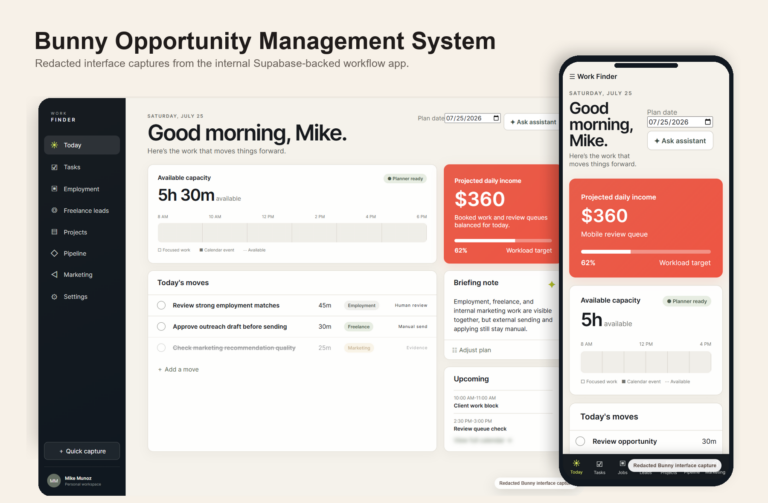
Bunny uses Supabase as its central data layer, connecting opportunities, contacts, drafts, pipeline activity, settings, daily plans, tasks, projects, calendar events, and qualification details in one system. Row-level security helps protect that information at the database level.
Separated Opportunity Workflows
Opportunity records are typed as employment, freelance, or marketing records so job applications, outreach leads, and internal studio work can share a system without pretending they follow the same process.
Qualification and Prioritization
The schema and interface support fit status, application status, lead status, display and review dates, priority scoring, effort estimates, score notes, and qualification detail records. That gives Bunny room to hold uncertain work in review instead of pushing it straight into action.
Drafting and Human Review
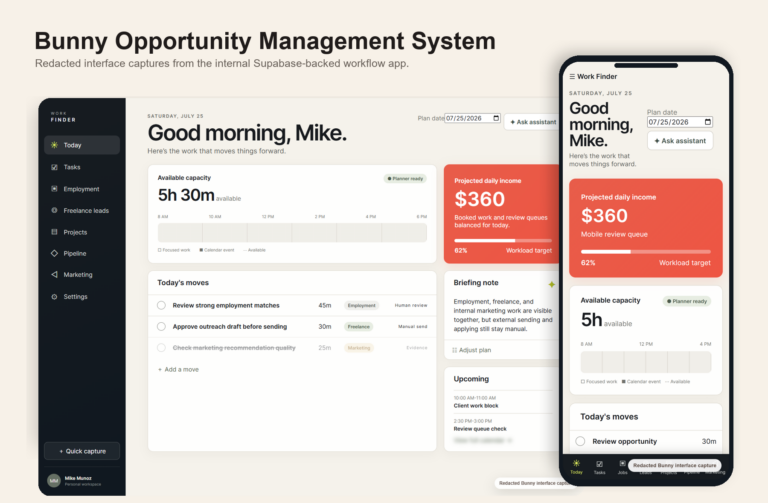
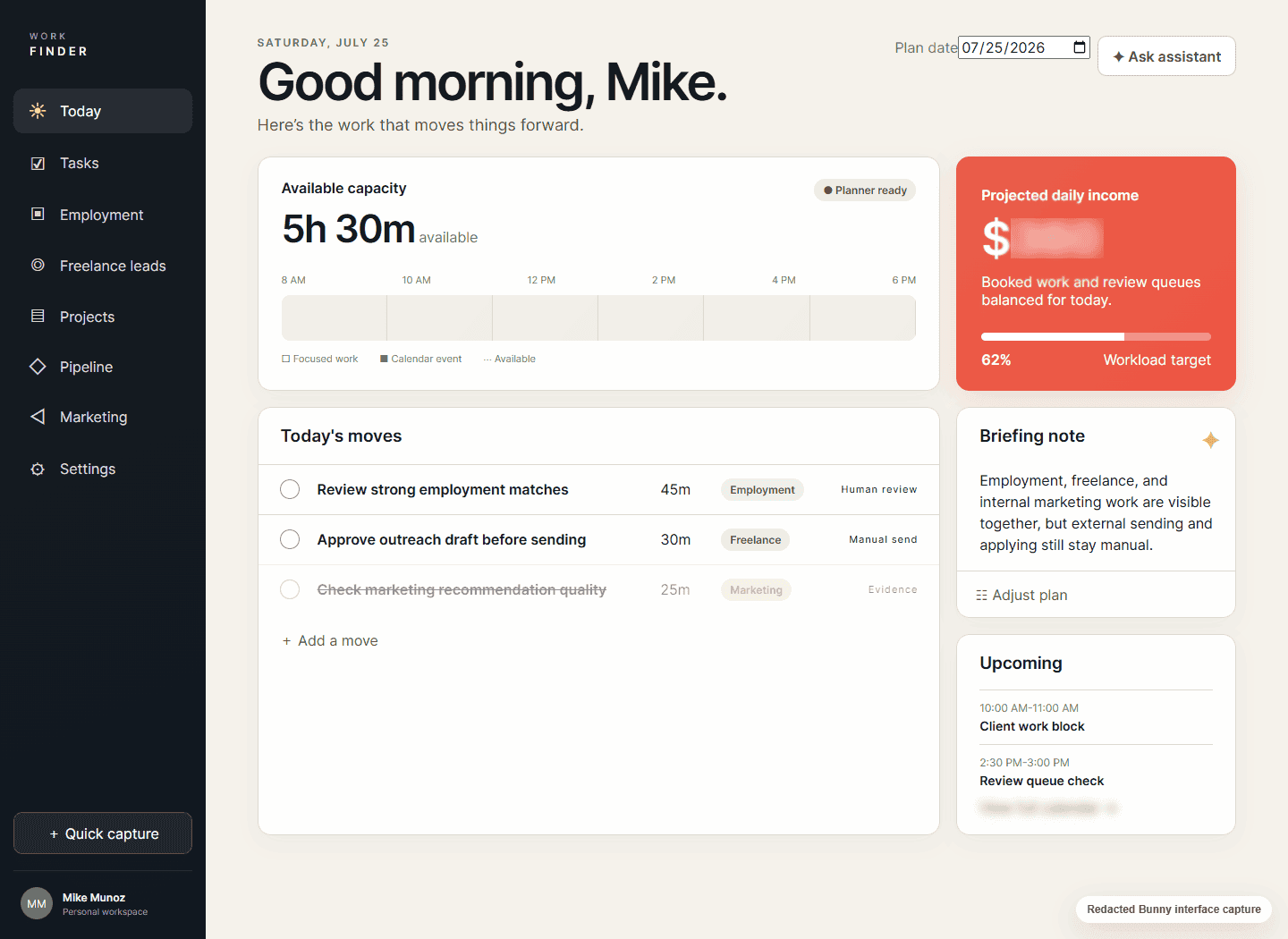
Cover letters and freelance outreach emails are stored as drafts or reviewable records. The application supports copying, opening draft flows, queueing tasks, and updating statuses, but the owner still decides when to send an email or submit an application.
Pipeline History and Follow-Up
Pipeline events record activity from manual, assistant, scraper, Gmail, and calendar sources so follow-ups and previous decisions can be considered before repeated outreach or duplicated work.
Daily Targets and Workload Planning
Daily targets are configurable planning limits, not quotas that justify weak records. The daily plan tables and UI connect capacity, tasks, opportunity reviews, calendar commitments, and internal work into one planning surface.
Evidence-Based Marketing Tasks
Marketing work is treated as a reviewable backlog. Completion-review behavior asks for page-specific evidence, a concrete problem, and a business consequence before a recommendation is treated as useful.
Current State and Roadmap
The current milestone is stabilizing Bunny’s business workflow foundation across employment, freelance, drafting, follow-up, marketing, and daily visibility. Qualification quality, task quality, and output relevance are still being refined through continued use.
The next planned milestone is a notification layer for completed scheduled work, failures, and records ready for review. Later phases include installable desktop/mobile access, mobile notifications, a stronger Bunny-specific personality, and a longer-term expansion into personal operations planning.
Responsibilities
- Product and workflow design for an internal opportunity-management system
- Supabase schema review and relationship modeling across opportunities, contacts, drafts, events, plans, tasks, and projects
- Frontend interface development with static HTML, CSS, JavaScript, and jQuery
- Status, review-state, and human-approval boundary design
- Filtering, scheduled visibility, daily planning, and workload-surface implementation
- Draft-generation workflow integration without automatic sending or application submission
- Pipeline-event and follow-up visibility across manual and scheduled sources
- Marketing-task review flow focused on evidence, problem, consequence, and owner approval
- Iterative refinement based on real employment search, freelance prospecting, and studio operations work
Key Features / Deliverables
Project Outcomes
Project Gallery