Back to case studies

Coats WordPress to SAP Sales Cloud Integration

A custom WordPress and SAP Sales Cloud integration that transforms one complex Gravity Forms workflow into correctly mapped leads, service requests, product inquiries, customer lookups, and territory-based assignments.

View project
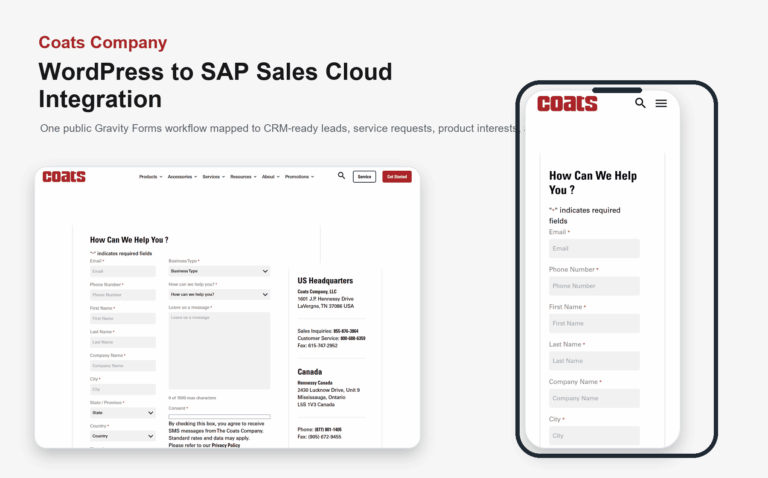
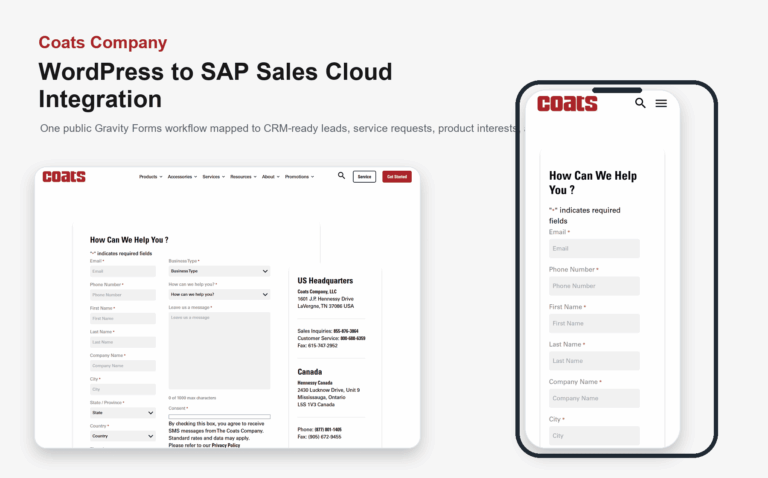
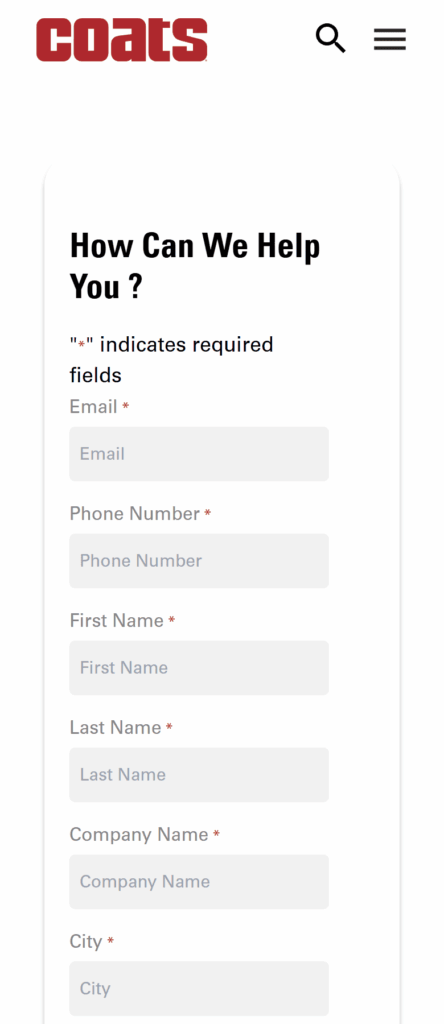
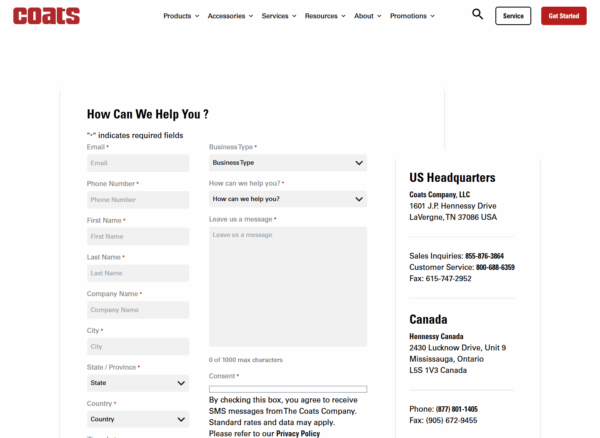
Coats WordPress contact form shown on desktop and mobile screens.

Coats Company needed its public WordPress contact form to do more than send a basic notification. The form had to collect contact, business, location, request-type, product-interest, and customer-identification details, then support several downstream sales and service workflows.

The first approach relied on a generic Gravity Forms webhook. That was not enough for this enterprise CRM workflow because SAP Sales Cloud expected specific object relationships, data types, required values, and mapped identifiers rather than the human-readable labels shown to website visitors.

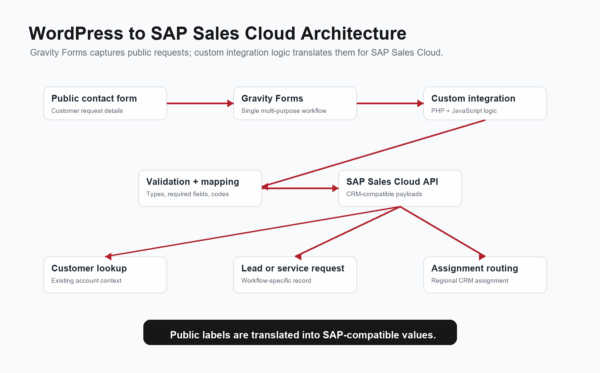
End Everything Studios provided white-label WordPress and integration development to replace that brittle webhook path with a custom integration approach around Gravity Forms, PHP, JavaScript, REST-style API communication, and SAP Sales Cloud mapping.

The completed integration is documented as live and in production, with planned future expansion for newsletter workflows and additional product ROI information.

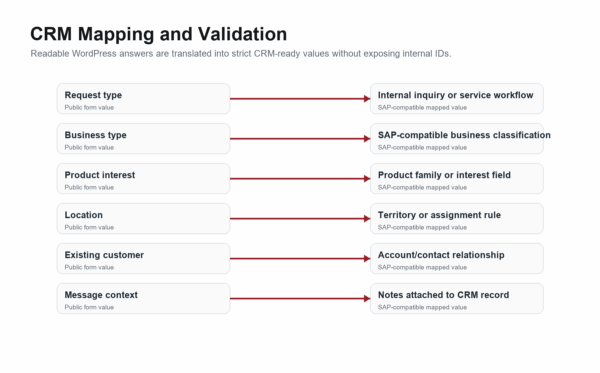
The public form looked straightforward, but the business logic behind it was not. A readable form value such as a request type, business category, product interest, or location could require a specific SAP-compatible value, object relationship, required field, or assignment rule.

The integration also needed to support several workflows from one intake point: new product inquiries, service requests, parts replacement requests, product manual requests, training inquiries, general contact requests, customer lookup, product-interest tracking, and regional assignment.

A generic webhook could not provide enough control for conditional payloads, customer matching, strict CRM mapping, and rejected-payload troubleshooting.

Our work created a custom mapping layer between the WordPress form and SAP Sales Cloud. The public form could stay usable for customers, while the integration translated visible selections into the structured values SAP required.

The discovery process was central to the implementation. Where SAP configuration details were incomplete, controlled records were created in SAP and inspected through Postman so the accepted object shapes, required fields, value types, and relationships could be understood without exposing private CRM data.

The live form confirms the multi-workflow intake structure: email, account and customer identifiers, phone, name, company, city, state or province, country, zip code, business type, request type, product-interest options, message, and consent fields. Public request paths include service requests, new product inquiries, parts replacement, product manuals, training, and other inquiries.

For publication safety, internal SAP identifiers, routing data, connection details, credentials, and real customer examples are intentionally omitted.

  • Replacing an unsuccessful webhook-based SAP integration
  • Reverse-engineering SAP object requirements with controlled test records
  • Mapping public form values to SAP-compatible internal values
  • Building custom PHP integration logic for CRM workflows
  • Supporting JavaScript-assisted customer lookup and form behavior
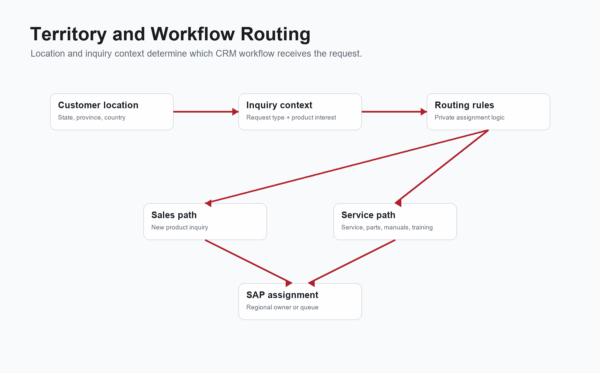
  • Routing inquiries to appropriate regional CRM assignments
  • Tracking selected product interests for downstream CRM context
  • Validating field types and required values before CRM submission
  • Logging and troubleshooting rejected API payloads
  • Supporting production deployment and ongoing integration planning
Multi-purpose Gravity Forms workflow One public form supports sales, service, parts, manuals, training, and general requests
SAP customer lookup Email-based lookup behavior supports existing customer context without exposing customer data
Existing-account identification Account and customer identifier fields preserve CRM relationship context
New lead workflow New product inquiry submissions are mapped for lead-generation handling
Service-request workflow Service-related request paths are handled separately from product inquiries
Product-interest tracking Equipment categories are captured for downstream CRM context
Territory-based routing Location and inquiry context support regional assignment logic
Custom PHP integration Server-side logic handles CRM communication and payload mapping
JavaScript form behavior Front-end scripting supports lookup and field-population behavior
Strict field-type mapping Human-readable form labels are translated into CRM-compatible values
API error troubleshooting Rejected payloads are logged and refined during integration testing
Live production deployment The integration is documented as live and currently in production
Replaced a generic webhook that could not support the required SAP workflows
Created a maintainable mapping layer between WordPress and SAP Sales Cloud
Supported sales, service, parts, manuals, training, and general inquiries through one form
Connected public inquiries with existing SAP customer context where lookup data is available
Captured product interest alongside inquiry details
Routed qualifying inquiries toward appropriate regional CRM assignments
Reduced the need for staff to manually reinterpret website submissions before CRM entry
Established a repeatable process for discovering undocumented SAP requirements
Deployed an integration documented as active in production
Created a foundation for future newsletter and product ROI enhancements

Need help untangling a custom WordPress platform?

We modernize legacy systems, repair integrations, and build dependable functionality around the workflows your organization already relies on.