Back to case studies

Architectural Glass Custom Shopify Configurator

A custom Shopify configurator that calculates made-to-order glass pricing from dimensions, square-foot tiers, perimeter-based edge treatments, and tempering without creating temporary variants for every customer configuration.

View project
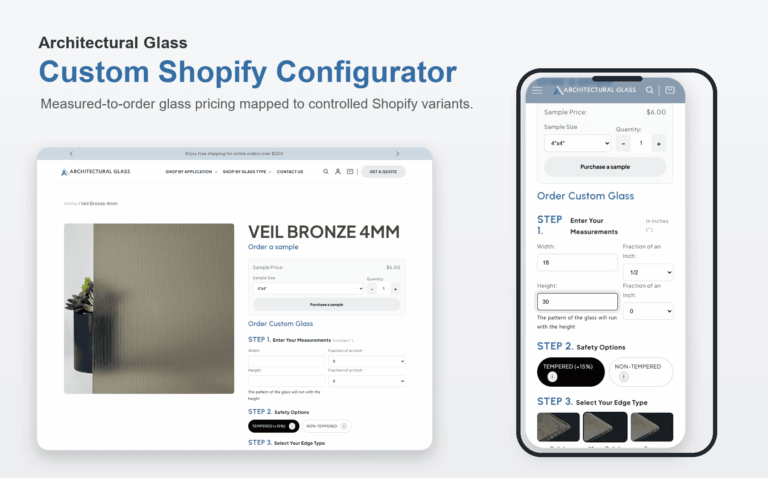
Architectural Glass Shopify configurator shown on desktop and mobile screens.

Architectural Glass sells custom-cut glass panels whose prices depend on customer-entered dimensions and fabrication choices.

The previous configuration workflow relied on runtime variant generation. Each custom combination could create a new Shopify variant during the shopping process, even when the customer never completed the purchase. That cluttered product administration, made sold configurations harder to distinguish from abandoned ones, and introduced reliability problems around duplicate configurations and navigation.

End Everything Studios provided white-label Shopify development support to replace that behavior with a custom Liquid and JavaScript interface. The configurator calculates width, height, square footage, perimeter, tempering, and edge-treatment choices, then maps those selections to controlled Shopify variant buckets.

The result is a production storefront experience that gives customers a guided made-to-order interface while keeping pricing and checkout inside Shopify’s standard product-form flow.

The product could not be priced cleanly with a simple static option picker. Customers needed to enter exact dimensions, choose safety options, and select fabrication details, while the store still needed controlled pricing records.

The earlier app-based workflow generated variants dynamically during configuration. That approach created abandoned one-off variants, made Shopify administration harder to manage, exposed temporary configurations as product records, and increased the chance of duplicate-variant or browser-navigation failures.

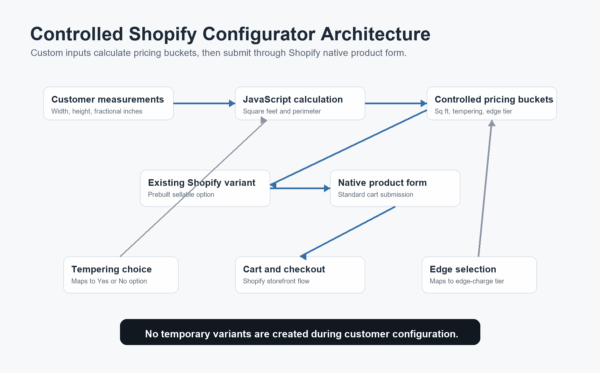
Our work replaced runtime variant generation with a controlled Shopify pricing architecture. Customer-facing controls collect dimensions and fabrication choices, while JavaScript calculates the pricing inputs and synchronizes the native Shopify option selectors.

From the live storefront and project code, the measured area is calculated as width multiplied by height divided by 144. That square footage is rounded up into predefined square-foot buckets from 2 through 10 square feet. Edge pricing is calculated from the panel perimeter, converted into feet, and mapped into edge-charge buckets from 1 through 14 feet when an edge treatment uses a tiered charge.

Product-specific JSON controls which edge treatments are available. Some products expose only a seamed edge, while others expose polish, micro-polish, or beveled options. Tempering is handled through the existing Shopify variant option structure rather than by creating new variants during the customer session.

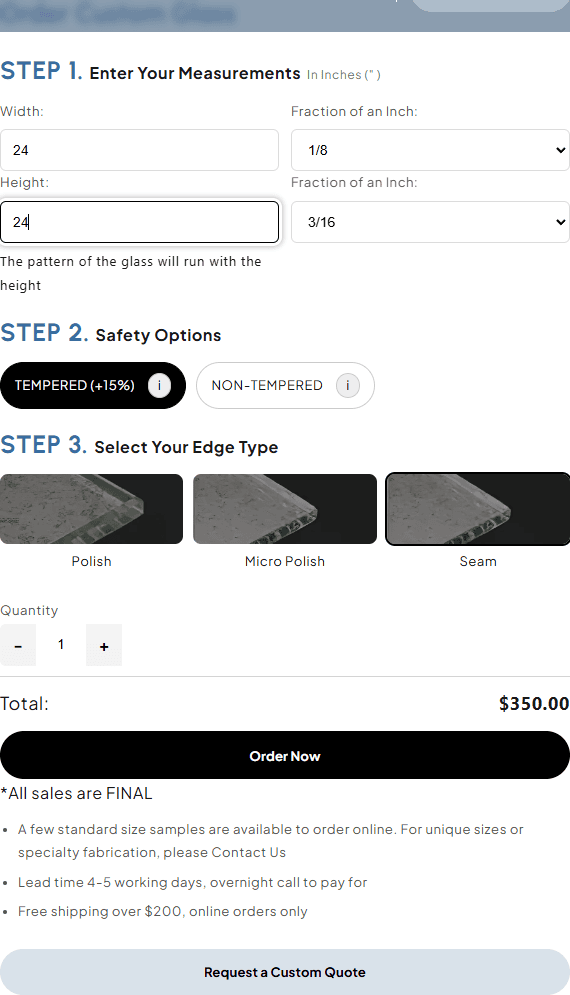
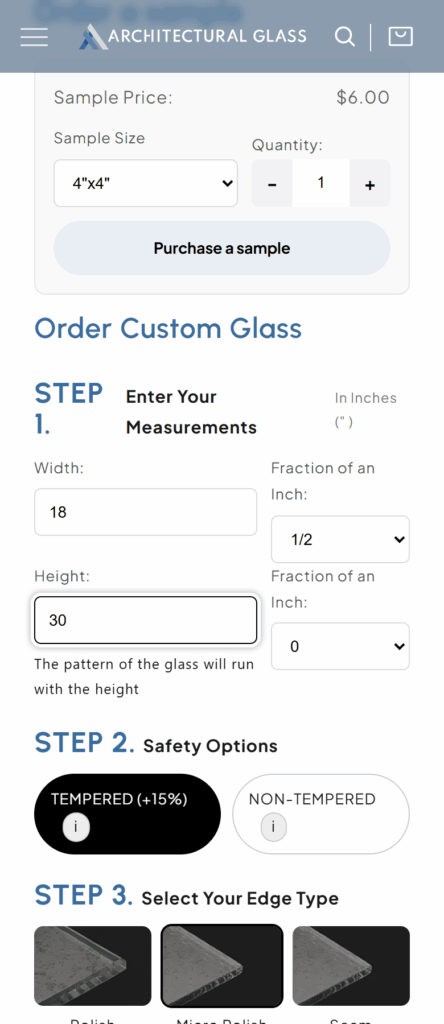
The interface keeps the storefront interaction simple: customers see measurement fields, safety choices, edge cards, quantity, and a live total, while Shopify receives a controlled variant selection through its normal product form.

  • Replacing an unreliable runtime variant-generation workflow
  • Building a custom measurement and pricing interface
  • Calculating square footage from customer-entered dimensions
  • Mapping calculated sizes into controlled Shopify variant buckets
  • Calculating perimeter for edge-treatment pricing
  • Mapping tempering and edge selections to existing Shopify variant options
  • Connecting the custom interface to the real Shopify product form
  • Testing responsive configurator behavior across desktop, tablet, and mobile views
  • Troubleshooting duplicate and navigation-related failures described in the project brief
  • Supporting live production deployment
Custom width and height entry Whole-inch and fractional-inch inputs for made-to-order glass panels
Automatic square-foot calculation JavaScript calculates area and maps it to a controlled pricing bucket
Automatic perimeter calculation Edge treatments use panel perimeter to choose a pricing tier
Controlled square-foot pricing buckets Existing Shopify variants represent predefined pricing ranges
Tempering variant mapping Customer-facing safety choices synchronize to Shopify variant options
Product-specific edge rules JSON configuration controls available edge treatments per product
Native Shopify form synchronization The custom UI updates the real storefront option selectors
Separate sample purchase flow Customers can buy a fixed sample without entering custom measurements
Responsive configurator interface The product builder remains usable across desktop, tablet, and mobile viewports
No runtime variant creation Customer configuration maps to existing variants instead of generating temporary product records
Eliminated temporary variant creation during customer configuration
Kept made-to-order pricing inside a predefined Shopify variant structure
Reduced abandoned one-off variant clutter inside Shopify
Made product administration cleaner by separating real pricing buckets from customer-entered measurements
Reduced duplicate-variant and browser-navigation failures tied to runtime variant creation
Supported product-specific edge rules without a separate custom ecommerce backend
Maintained Shopify’s standard cart and checkout flow for the custom configurator
Delivered a live responsive configurator for custom glass ordering

Need help untangling a custom WordPress platform?

We modernize legacy systems, repair integrations, and build dependable functionality around the workflows your organization already relies on.